If you've started researching raw food diets for your dog, you've probably come across both terms — "raw feeding" and "the BARF diet" — and wondered whether they mean the same thing. It's one of the questions I get asked most often, and it's a really important one. Because while all BARF is raw feeding, not all raw feeding is BARF. And that distinction matters more than you might think.
Let me explain.
What is Raw feeding?
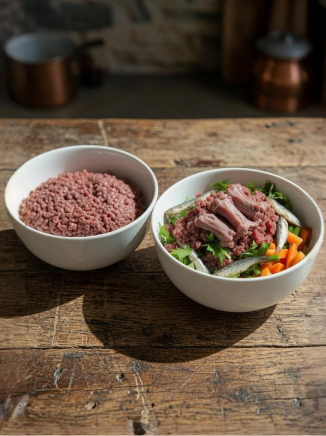
Raw feeding is exactly what it sounds like — feeding your dog a diet based on uncooked, unprocessed ingredients rather than commercial kibble or tinned food. It's a broad umbrella term that covers several different approaches, all of which share the same basic principle: that dogs thrive on food in its natural, unprocessed state.
Within raw feeding, you'll find various methods and philosophies. Some people feed purely raw meat and bones. Others add vegetables and fruit. Some follow strict ratios and guidelines, while others take a more instinctive approach. Raw feeding, as a concept, doesn't prescribe exactly what those ingredients should be or in what quantities — it simply describes the general practice of feeding dogs uncooked food.
This is where the BARF diet comes in.
What is the BARF diet?
BARF stands for Biologically Appropriate Raw Food — a term that tells you everything you need to know about its philosophy. The BARF diet isn't just about feeding raw food. It's about feeding the right raw food, in the right balance, in a way that mirrors what dogs evolved to eat.
The BARF diet is a structured, specific approach to raw feeding that carefully balances:
● Raw meat and fish
● Organ meat
● Raw meaty bones
● Fruit and vegetables
● Seeds, mushrooms and oils
Every element is included for a reason. Every ratio matters. The goal is to replicate, as closely as possible, the ancestral diet that dogs' bodies were designed to thrive on — not just to feed them something raw.
So what's the key difference?
Think of it this way. Raw feeding tells you what to do. The BARF diet tells you exactly how to do it right.
You could put almost any uncooked ingredient in front of your dog and technically call it raw feeding. But without understanding the nutritional balance, the correct ratios of muscle meat to organ meat, the role of different vegetables, or which foods to avoid entirely, you risk creating a diet that is raw but not balanced.
A dog fed an unbalanced raw diet may appear to be thriving on the surface, while silently developing nutritional deficiencies or imbalances that only become apparent over time. This is one of the most common mistakes raw feeders make — and it's entirely avoidable.
The BARF diet removes that guesswork. It provides a clear, researched, biologically grounded framework that ensures your dog gets everything they need — and nothing they don't.
Why does this matter for your dog?
Because dogs are not wolves, and the modern domestic dog has specific nutritional needs that a purely instinct-led approach to raw feeding doesn't always meet. A certified BARF nutritionist understands the science behind canine biology and uses that knowledge to create a diet that is not just raw, but genuinely complete and balanced.
The difference between raw feeding and the BARF diet is the difference between good intentions and expert knowledge. Both come from a place of love for your dog, but one is guided by a proven nutritional framework, and that makes all the difference.
Which is right for your dog?
If you're drawn to raw feeding because you want to give your dog the best possible diet, the BARF approach is the gold standard. It takes the principles of raw feeding and elevates them into something truly biologically appropriate — tailored to your dog's age, breed, weight, activity level and health history.
No two dogs are the same, which is why a one-size-fits-all approach — whether that's kibble or a generic raw feeding plan — will never give your dog exactly what they need.
A personalised BARF diet, created with expert guidance, will.
Curious about whether the BARF diet is right for your dog? Book a consultation and we'll create a tailored feeding plan specifically for your dog — because every dog deserves a diet designed just for them.
Ellie Kelland is the UK's first certified BARF nutritionist, a qualified animal naturopath, and a veterinary science graduate. She founded BARF time to help dog owners give their pets the diet nature intended.
Other reads you might find interesting...

"Fully balanced." 🤔 It's the phrase on almost every tin and pouch of commercial dog food. And it's the phrase that gives most dog owners the most reassurance. But do you know what "fully balanced" actually means, legally? It might not be what you think

It's the question most people in the pet food industry don't want you to ask. Here's the honest truth I wish someone had told me before I lost my beloved Cocker Spaniel Clo to cancer in 2022.

Thinking of mixing kibble and raw food? It sounds like a sensible compromise — but here's why it's not ideal and what to do instead.

Do Vets Recommend the BARF Diet? It’s one of the first questions dog owners ask when they start researching raw feeding, and …